
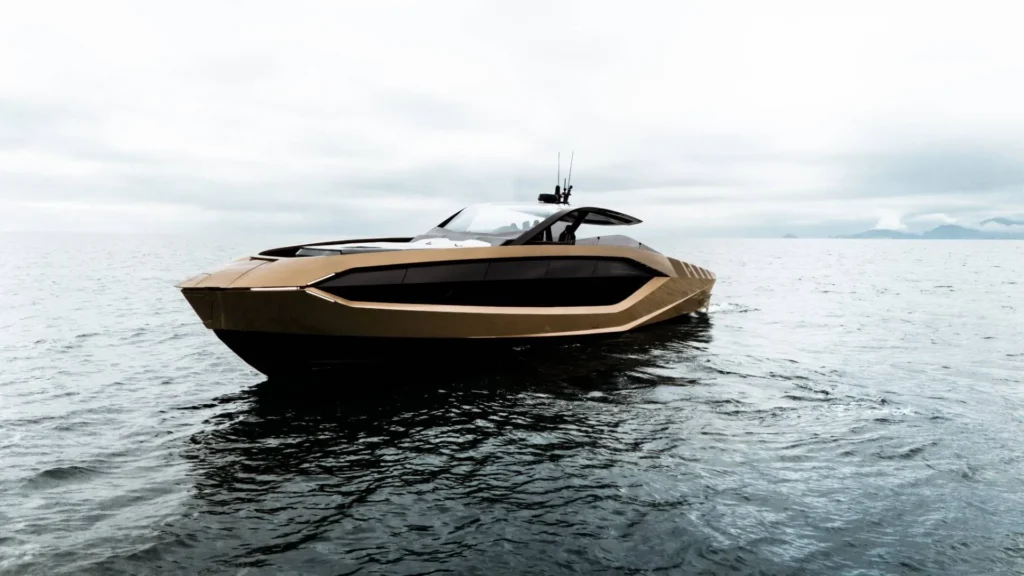
When most people hear the phrase Lamborghini yacht, they imagine a supercar engine dropped into a boat, high-revving, loud, and built for raw speed. It’s a logical assumption, given Lamborghini’s reputation for extreme V10 and V12 powertrains.
But the reality is far more considered. The Lamborghini yacht engine is not an automotive powerplant at all. It is a purpose-built marine solution, chosen not for branding impact, but for reliability, sustained performance, and engineering suitability at sea.
This blog explains why Lamborghini’s car engines were never an option for the yacht, why MAN V12 marine engines were selected instead, and what this decision reveals about how real performance works on water, not on roads.
A yacht engine problem, not a branding question
The vessel commonly referred to as the Lamborghini yacht is officially the Tecnomar for Lamborghini 63, developed as a collaboration rather than a conversion project. From the outset, the goal was not to adapt automotive hardware for marine use, but to build a yacht engineered specifically for high-performance operation at sea.
Lamborghini’s role centred on design philosophy, material direction, and performance intent. Tecnomar handled naval architecture, structural engineering, and propulsion decisions. This clear division of responsibility ensured that every major system was selected based on marine requirements, not brand association.
That distinction becomes most evident in the choice of engine. Rather than attempting to adapt a road-going powertrain, the yacht is powered by twin V12 marine engines from MAN Engines, each rated at 2,000 horsepower. This single decision underscores the project’s engineering-first approach, prioritising reliability, sustained load capability, and suitability for open-water performance over symbolic branding.
Why automotive performance logic doesn’t work at sea
At a fundamental level, car engines and yacht engines are built for entirely different operating conditions.
Automotive engines are designed for:
- Short bursts of peak performance
- Rapid acceleration followed by variable load
- Air-based cooling systems
- Environments free from corrosion
Marine engines, by contrast, must:
- Run continuously under sustained load
- Deliver consistent torque rather than peak RPM
- Operate with closed-loop cooling systems
- Withstand saltwater, humidity, and vibration
In fact, marine propulsion engines are commonly engineered to meet Continuous Duty ratings, meaning they are designed to operate at approximately 70 to 90 per cent of their rated load continuously for extended periods.
A Lamborghini road engine thrives on high-revving intensity. A yacht engine must prioritise endurance, thermal stability, and reliability over long periods. Running a car engine at sea, especially at sustained speeds, would dramatically reduce its lifespan and compromise safety.
This is also why raw horsepower figures can be misleading. On water, speed is determined by torque delivery, hull efficiency, and power-to-weight ratio, not engine revs alone. High RPM performance, which defines supercars, offers little advantage if it cannot be sustained reliably.
For this reason, using an automotive powertrain would undermine the very idea of performance yachting.
Why MAN V12 engines were the right choice
The Lamborghini yacht engine is based on twin V12 marine units supplied by MAN Engines, chosen specifically for their suitability in high-performance yachting rather than for headline power figures.
MAN V12 marine engines are engineered for demanding marine environments and are known for:
- Continuous high-load capability
- Strong low-to-mid RPM torque delivery
- Proven offshore reliability
- Long service intervals and thermal resilience
These characteristics allow the yacht to deliver exceptional performance while maintaining operational stability and mechanical longevity. Paired with the yacht’s lightweight carbon-fibre construction, the engines support efficient planing and sustained high-speed operation without excessive mechanical strain.
In short, the choice of MAN engines reflects engineering discipline rather than brand compromise.
Experiencing the Tecnomar for Lamborghini 63
In practical terms, this engineering-led approach shapes how the Tecnomar for Lamborghini 63 is meant to be experienced on the water. It is a performance-led yacht designed to deliver stability, control, and composure at speed when operated as intended.
For those looking to experience the Tecnomar for Lamborghini 63 in Dubai, PET Yachts offers access to the yacht with a professional crew and an operational approach aligned with its engineering design.
Book the Tecnomar for Lamborghini 63 with us and experience it as a true performance yacht.
FAQs
A performance-led yacht prioritises speed, responsiveness, and lightweight construction, whereas traditional luxury cruisers focus more on interior volume, range, and long-distance comfort. The Tecnomar for Lamborghini 63 is designed to plane quickly, remain stable at higher speeds, and deliver a more dynamic on-water experience rather than extended cruising autonomy.
Yacht engines operate under continuous load for extended periods, often at high output, and must function reliably in corrosive saltwater environments. Unlike car engines, which experience short bursts of peak performance, marine engines are designed for endurance, thermal stability, and consistent torque delivery. As a result, engine suitability plays a central role in how a performance yacht behaves, feels, and lasts in real-world use.
High-performance yachts of this type are designed primarily for shorter, high-impact journeys rather than extended long-range cruising. Their design prioritises speed, agility, and on-water experience over fuel range and onboard volume.
PET Yachts operates the Tecnomar for Lamborghini 63 with a professional captain and experienced crew who are familiar with high-performance yachts and their operating characteristics. This ensures the yacht is handled in line with its design intent, delivering a controlled, stable, and composed experience at speed rather than treating it as a standard leisure cruiser.
PET Yachts approaches the Tecnomar for Lamborghini 63 as a flexible platform rather than a fixed-format charter. While the yacht is performance-led by design, the onboard setup, pacing of the journey, and use of amenities can be adjusted to suit different occasions, such as relaxed daytime cruising, celebratory outings, or content-focused experiences, without compromising safe and correct operation.